You’re standing at the counter of a Shinto shrine in Kyoto. Behind the glass you can see small fabric pouches in every color, wooden plaques hanging from hooks, and a calligrapher quietly writing in someone’s book. There are signs — in Japanese — listing prices and options you don’t fully understand.
You want to bring something home. But what are all these things, and which one should you get?
The three items you’re most likely to encounter are goshuin, omamori, and ema. They look nothing alike, they serve completely different purposes, and they come with different rules. Here’s how to tell them apart — and how to choose.
The Quick Version
| Goshuin (御朱印) | Omamori (お守り) | Ema (絵馬) | |
|---|---|---|---|
| What it is | Hand-brushed calligraphy + vermillion seal | Fabric charm in a brocade pouch | Wooden prayer plaque |
| You take it… | Home, in your goshuincho | With you (bag, wallet, phone) | You leave it at the shrine |
| Purpose | Sacred record of your visit and prayer | Portable blessing or protection | A written wish for the kami to read |
| Created for you? | Yes — written by hand, in the moment | No — pre-made (but individually blessed) | You write on it yourself |
| Typical cost | ¥300–¥500 | ¥500–¥1,000 | ¥500–¥1,000 |
| Expiration | Never | Traditionally 1 year | Left at the shrine |
Now let’s look at each one properly.
Goshuin: The Calligraphy Seal
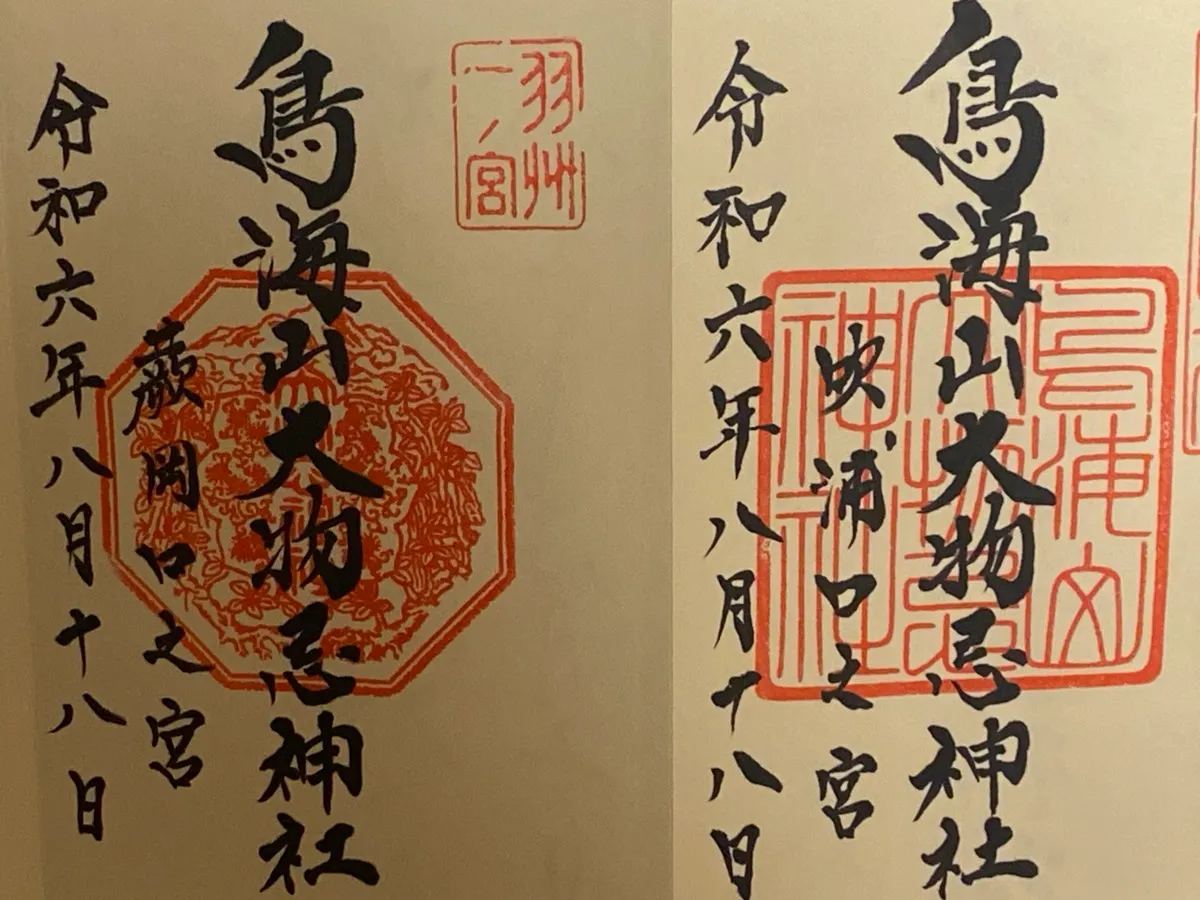
A goshuin is a hand-brushed inscription that a shrine priest or attendant creates in your special book (goshuincho) at the time of your visit. It typically includes the shrine’s name, the date, and one or more vermillion stamps pressed into the page.
Why It’s Special
Every goshuin is created in real time, by a human hand, specifically for you. The brushstrokes will never be exactly the same twice. It’s not a stamp you press yourself and it’s not mass-produced — it’s a skilled calligrapher translating a sacred tradition into ink on paper while you wait.
This is why goshuin feel less like souvenirs and more like records. Your goshuincho becomes a visual diary of everywhere you’ve prayed.
The History
Goshuin originated from an old Buddhist pilgrimage practice. Centuries ago, devout travelers would hand-copy entire sutras and present them at temples along their route. The temple would stamp the pilgrim’s book as proof of the offering. Over time, the sutra-copying was replaced with a simple prayer and donation, but the stamps remained. Shinto shrines later adopted the custom, and the modern goshuin was born.
How to Get One
- Pray first at the main hall — this is essential, not optional
- Find the goshuin counter (look for 御朱印 signs, usually at the shrine office)
- Hand your goshuincho open to the next blank page
- Pay the fee (¥300–¥500; place money on the tray, don’t hand it directly)
- Wait 1–5 minutes while the calligrapher writes
- Receive your book back with a bow
No goshuincho? Many shrines offer kakioki — pre-written goshuin on a loose sheet you can paste into a book later.
Who It’s For
Collectors, calligraphy lovers, travelers who want a meaningful keepsake from every sacred site they visit. If you’re the kind of person who journals or scrapbooks your trips, goshuin are for you.
Omamori: The Protective Charm
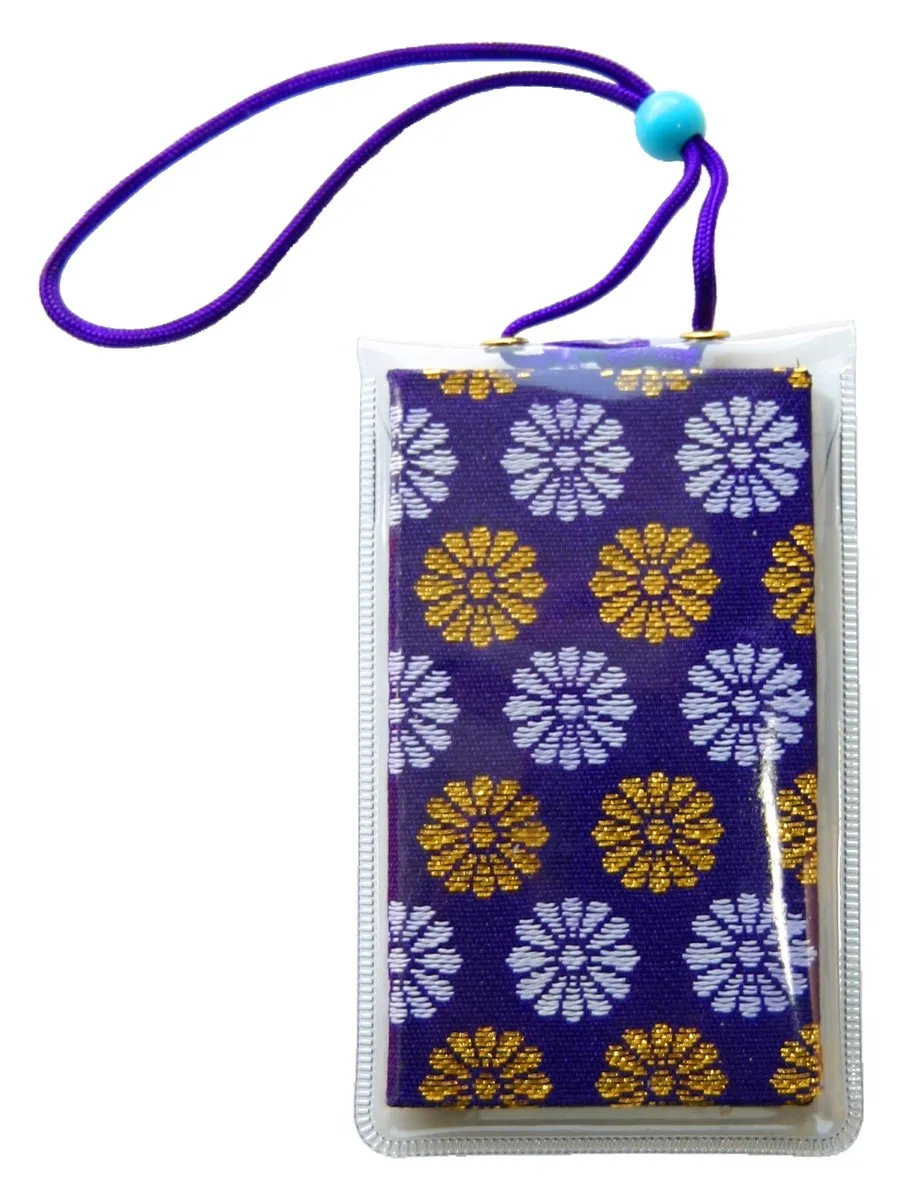
Omamori are small fabric amulets — usually about the size of a credit card — encased in colorful brocade pouches with a string loop. You’ll find dozens of varieties at any shrine or temple, each offering a specific type of blessing.
What’s Inside
Technically, there’s a small piece of paper or wood inside the pouch bearing a prayer or sacred inscription. You’re not supposed to open it — doing so is believed to release (and therefore lose) the blessing. The outer pouch is decorative and protective.
Types of Omamori
Shrines typically offer omamori for specific purposes:
| Type | Japanese | What It’s For |
|---|---|---|
| Traffic safety | 交通安全 (kōtsū anzen) | Safe driving and commuting |
| Academic success | 学業成就 (gakugyō jōju) | Passing exams, studying well |
| Good health | 健康 (kenkō) | Physical wellbeing |
| Romantic love | 縁結び (enmusubi) | Finding a partner |
| Safe childbirth | 安産 (anzan) | Healthy pregnancy and delivery |
| Business prosperity | 商売繁盛 (shōbai hanjō) | Success in business |
| General luck | 開運 (kaiun) | All-around good fortune |
Some shrines get creative: you can find omamori for pet health, IT security, safe air travel, and even good Wi-Fi signal. Seriously.
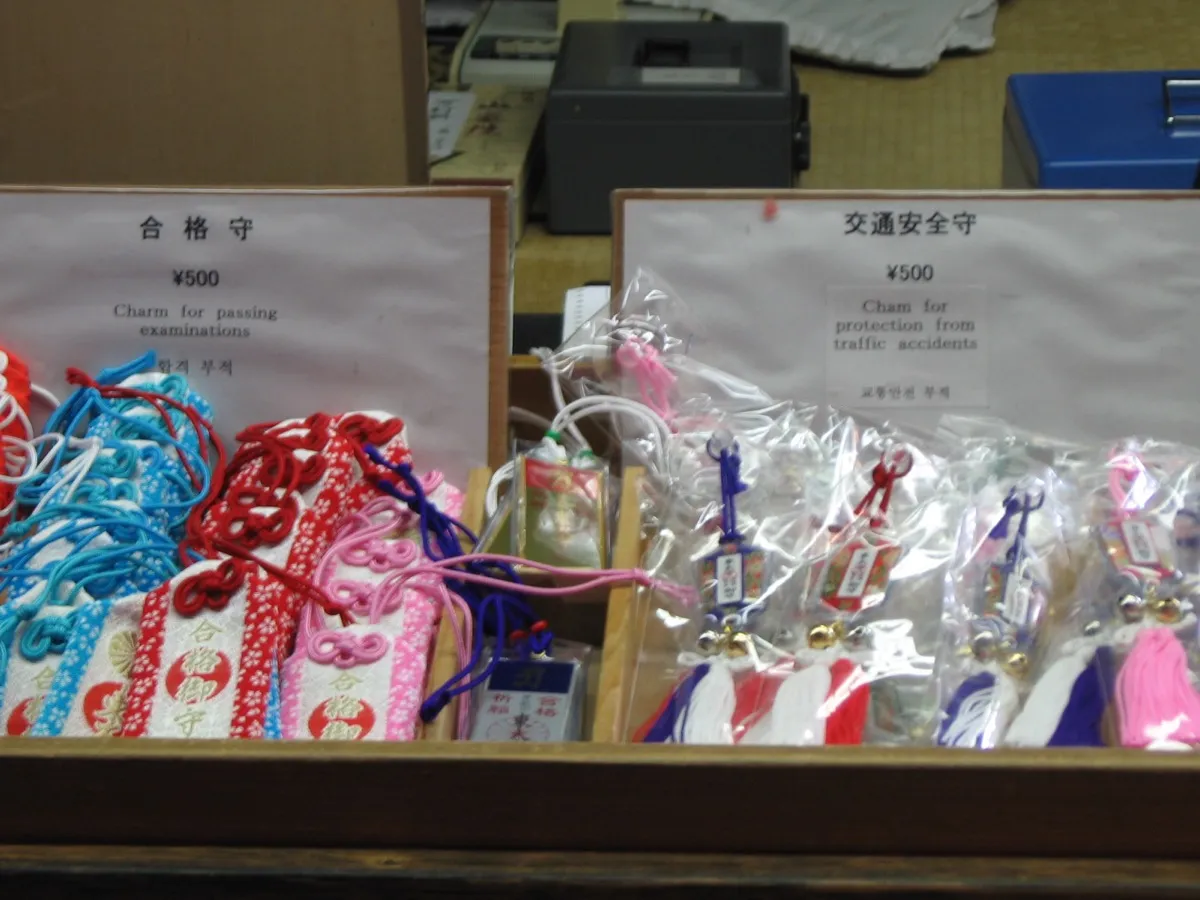
How to Get One
No ceremony required. Walk up to the charm counter (often labeled omamori お守り or juyo-sho 授与所), choose the one you want, pay, and take it with you. You can buy omamori for other people — they make popular gifts.
How to Use One
Carry it close to whatever you want protected:
- Traffic safety → Hang it from your rearview mirror or attach it to your bag
- Academic success → Keep it in your pencil case or backpack
- Romantic love → Carry it in your purse or pocket
- General luck → Attach it to your phone or keychain
Do They Expire?
Traditionally, yes. An omamori is considered effective for one year. After that, you’re supposed to return it to a shrine (any shrine, not necessarily the one where you bought it) for proper disposal in a ritual fire called otakiage (お焚き上げ).
In practice, many people — especially tourists — keep their omamori indefinitely as keepsakes. No one will be offended.
Who It’s For
Everyone. Omamori are the most accessible shrine item for visitors. They’re affordable, portable, and come in beautiful designs that work as gifts. If you want to bring something home from a shrine without committing to a full collection hobby, an omamori is the easy choice.
Ema: The Prayer Plaque
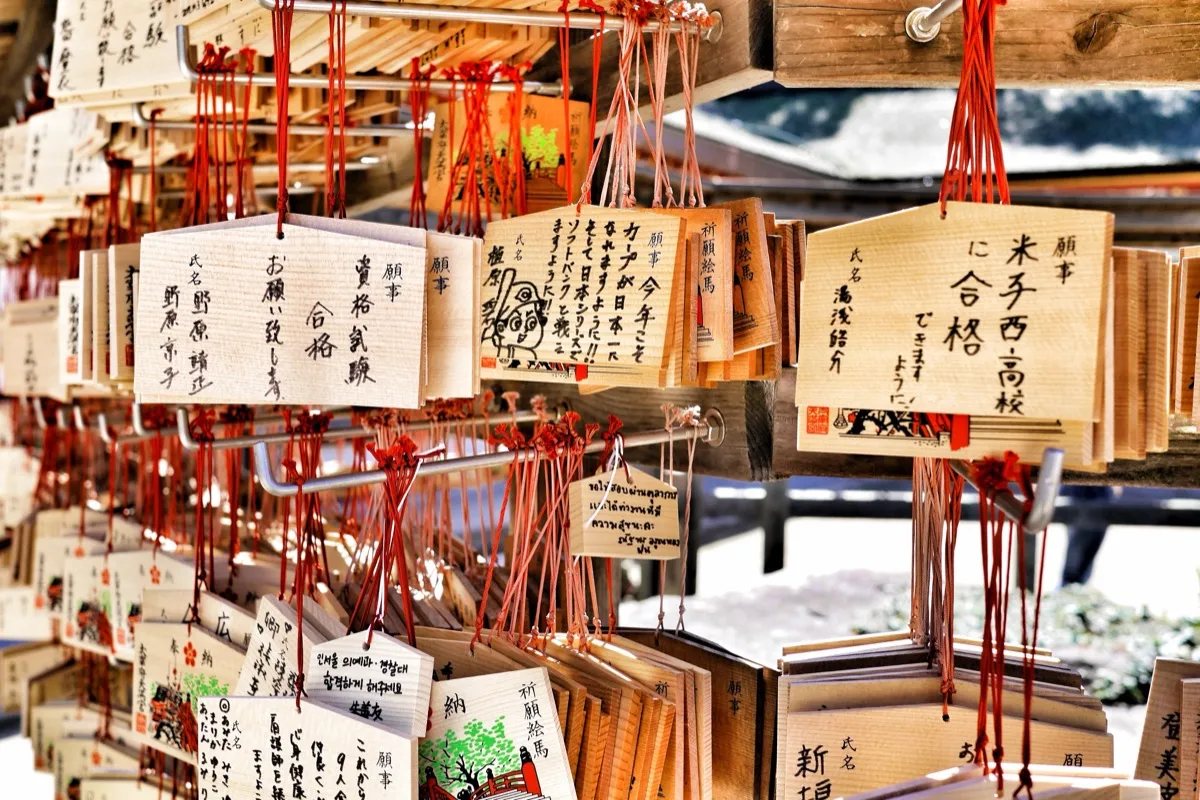
Ema are flat wooden plaques — roughly the size of a postcard — with an illustration on the front and a blank space on the back where you write your wish.
The name literally means “picture horse” (絵馬). In ancient Japan, people donated real horses to shrines as offerings to the gods. Since most people couldn’t afford a horse, they began offering wooden boards with pictures of horses painted on them instead. The illustrations have since evolved to include the shrine’s motifs, zodiac animals, seasonal designs, and more — but the name stuck.
How to Use One
- Buy an ema at the shrine’s charm counter (¥500–¥1,000)
- Write your wish on the blank side — in any language. Be specific: “I want to pass the JLPT N2 exam in July” is better than “I want good luck”
- Hang it on the ema rack at the shrine (you’ll see hundreds of others already hanging there)
- The kami are believed to read the wishes. That’s the entire mechanism.
What People Wish For
Reading the ema rack at a popular shrine is one of the quietly fascinating experiences in Japan. You’ll see wishes in dozens of languages:
- Academic success (the most common — especially at shrines like Kitano Tenmangu in Kyoto or Yushima Tenjin in Tokyo)
- Health for family members
- Romantic wishes (“I hope Takeshi notices me”)
- Career goals
- Safe travel
- World peace (occasionally)
Should You Read Other People’s Ema?
They’re hanging in public, so yes — it’s completely normal to browse. But it’s considered poor form to mock or photograph specific personal wishes. Treat them the way you’d treat letters in a church prayer box.
Who It’s For
Anyone who has a specific wish or prayer. Ema are the most active of the three items — you’re not receiving something, you’re making a request. They’re particularly popular during exam season (January–March) and around New Year.
The Key Differences, Explained
Direction of the Blessing
This is the most important distinction:
- Goshuin = The shrine gives to you (a record of your prayer)
- Omamori = The shrine gives to you (ongoing protection)
- Ema = You give to the shrine (your wish for the kami)
Goshuin and omamori are things you receive. Ema are things you leave behind.
Effort and Ritual
| Item | Ritual required? | Effort level |
|---|---|---|
| Goshuin | Yes — you must pray first | Medium (pray → request → wait) |
| Omamori | No — just buy it | Low (choose → pay → carry) |
| Ema | Optional — writing the wish is the ritual | Medium (buy → write → hang) |
Permanence
- Goshuin are permanent. They go in your book and stay there forever.
- Omamori are temporary. They’re meant to be returned after one year.
- Ema are left at the shrine. You walk away without them.
Collectibility
- Goshuin are highly collectable. Every shrine’s goshuin is different, and many offer seasonal or limited-edition designs. Serious collectors visit hundreds of shrines.
- Omamori are somewhat collectable. Designs vary by shrine and the aesthetics can be stunning, but they’re mass-produced within each shrine.
- Ema are not collectable. You write on them and leave them behind.
Can You Get All Three at the Same Shrine?
Yes — and you should, if you want the full experience. Here’s a typical flow:
- Enter through the torii gate and bow
- Purify your hands at the water basin
- Pray at the main hall (two bows, two claps, one bow)
- Write and hang your ema at the rack
- Request your goshuin at the counter
- Browse the omamori and pick one (or several) while your goshuin is being written
- Leave through the torii gate and bow
Total time: 20–40 minutes. Total cost: roughly ¥1,500–¥2,500 for all three.
What About Ofuda?
You might also encounter ofuda (お札) — larger paper or wooden talismans meant to be placed on your home altar (kamidana) or a high shelf. They protect the household rather than the individual.
Ofuda are less practical for tourists since they’re designed for Japanese home worship. Unless you have a kamidana at home, goshuin, omamori, and ema are the three to focus on.
The Bottom Line
| What do you want? | Get this |
|---|---|
| A meaningful, unique record of your visit | Goshuin |
| Portable good luck to carry with you | Omamori |
| To make a specific wish to the gods | Ema |
| A gift for someone back home | Omamori |
| Something to collect across many shrines | Goshuin |
| The easiest option with no ceremony | Omamori |
| All of the above | Get all three — they complement each other |
There’s no wrong choice. Each one connects you to a different part of the shrine experience — the record, the blessing, or the wish. Take whichever speaks to you.
Or take all three. The kami won’t mind.
Collecting goshuin across Japan? Goshuin Meguri lets you photograph, organize, and map every goshuin in your collection — so you can relive each visit long after you’ve left the shrine.
Image credits: Goshuin — Immanuelle (CC BY 4.0) / Omamori — Timothy Takemoto (CC BY 2.0) / Omamori display — Syced (CC0) / Ema & hero image — travel oriented (CC BY-SA 2.0). All images via Wikimedia Commons.